
Is Multi-Channel Marketing Worth It for Local Service Businesses?
Table of Contents
- The Real Question: Focus or Diversify?
- Best Marketing Channels for Local Service Businesses
- Local Business Marketing Examples That Work
- The Budget Reality: When Spreading Yourself Too Thin Backfires
- How to Measure Marketing Channel Performance
- Multichannel vs. Omnichannel Marketing for Local Services
- Building Your Multi-Channel Strategy: A Practical Pilot Plan
- Conclusion: Is It Worth It for Your Business?
- Frequently Asked Questions
Last Updated: October 8, 2026
The Real Question: Focus or Diversify?
Is multi-channel marketing worth it for local service businesses? The answer isn’t a simple yes or no. It depends on your budget, team size, and how much you’re willing to spread your attention across different channels.
Most local service businesses start with one channel. Maybe it’s Google Local Search. Maybe it’s Facebook ads. They pick one, commit resources, and hope it works. But here’s what we’ve learned after years in the digital marketing space: the businesses that grow fastest aren’t choosing between channels. They’re building a coordinated strategy where each channel feeds the others.
The trap is thinking you need to master every platform at once. You don’t. The real skill is knowing which channels matter for your specific situation, then executing them well enough that they reinforce each other.
Let’s break down when multi-channel marketing actually pays off, and when it’s just noise.
Best Marketing Channels for Local Service Businesses
Not all channels work equally for local service businesses. Some drive immediate leads. Others build long-term trust. The best approach combines both types.
Search and Local Discovery
Local search is the foundation. When someone needs a plumber, electrician, or contractor, they search first. Google Local Search results dominate these queries.
This is where most local service businesses should start. It’s where demand already exists. You’re not creating interest, you’re capturing it.
The basics matter here:
- A complete Google Business Profile with current hours and photos
- Consistent name, address, and phone number across the web
- Customer reviews (more reviews signal trust to Google and customers)
- Local keywords in your website content
Local discovery also includes map apps, review sites, and directory listings. These channels work best when you maintain consistent information everywhere. When your address changes or your phone number updates, that inconsistency tanks your visibility.
Paid Advertising and Direct Response
Paid ads give you control. You pick your audience, set your budget, and measure results directly.
For local service businesses, the most effective paid channels are typically:
- Google Ads (search and local service ads)
- Facebook and Instagram ads (good for building awareness and retargeting)
- Direct mail with strategic targeting (especially effective when combined with digital)
Paid ads work fast. You can launch a campaign and see leads within days. But they cost money every day the ads run. Once you stop paying, the leads stop coming.
This is where budget discipline matters. Many small teams waste money on broad targeting or weak creative. The fix is testing smaller budgets first, measuring what works, then scaling.
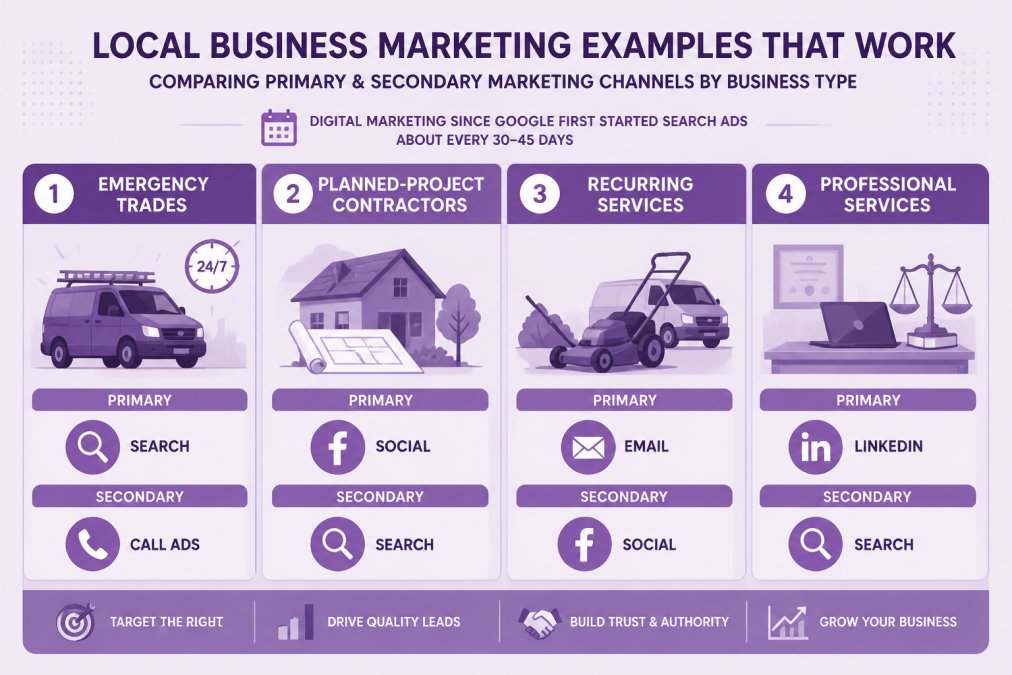
Local Business Marketing Examples That Work
The strongest multi-channel strategies we’ve seen share a common trait: they match channel mix to the economics of the work, not to a generic playbook. Here’s what that looks like across different local service models.
Emergency-driven trades (plumbing, HVAC, electrical, restoration)
These businesses live on urgency. A burst pipe at 11 p.m. doesn’t wait for a nurture sequence. The channel mix reflects that:
- Primary: Google Local Search and Local Services Ads capture the “near me” and “emergency” queries that dominate this category.
- Secondary: Google Ads on high-intent emergency keywords during peak seasons (summer HVAC, winter plumbing).
- Supporting: A retargeting campaign on Facebook and Instagram to stay visible to homeowners who researched but didn’t book.
A common pattern: average job values in these trades often range from a few hundred dollars for a repair to several thousand for a replacement. That math matters. If your average ticket is $400, you can’t afford a $150 cost per lead on a channel that converts at 20%. If your average ticket is $4,000, that same lead cost is a bargain. The channel mix should follow the job value, not the other way around.
Seasonality is another lever. Many HVAC companies shift budget toward paid search in June and July, then pull back in shoulder months and lean on email to past customers for maintenance plans. That’s multi-channel marketing working with the business cycle, not against it.
Planned-project contractors (remodeling, roofing, landscaping, painting)
These jobs are larger, less urgent, and involve more research. The buying cycle can stretch from weeks to months.
- Primary: Local SEO and content that answers research questions (“how much does a roof replacement cost,” “best time to paint a house exterior”).
- Secondary: Facebook and Instagram ads targeting homeowners in specific ZIP codes or neighborhoods, often with before-and-after visuals.
- Supporting: Direct mail to the same neighborhoods where digital ads are running. The combination of seeing a postcard and then a social ad creates familiarity that either channel alone rarely achieves.
Service radius matters here. A roofer who only works within 25 miles of the shop shouldn’t be running broad metro campaigns. Tight geo-targeting on every channel keeps spend concentrated where the crew can actually show up.
Recurring-service businesses (cleaning, pest control, lawn care, pool service)
These models depend on customer lifetime value, not one-time transactions. A pest control customer who stays three years is worth far more than a single treatment.
- Primary: Local search and a strong Google Business Profile with reviews.
- Secondary: Email and SMS for scheduling, reminders, and seasonal upsells.
- Supporting: Referral programs and neighborhood-specific direct mail.
The multi-channel advantage here is retention. A customer who found you through search, gets a reminder text before each service, and receives a seasonal email about additional treatments is far less likely to churn than one who only interacts at the point of sale.
Professional services (consulting, accounting, legal, coaching)
These businesses sell expertise, and the sales cycle is longer. Trust accumulates across touchpoints.
- Primary: Referrals and a website that demonstrates expertise.
- Secondary: LinkedIn presence and targeted outreach.
- Supporting: Email nurture sequences to past contacts and prospects who downloaded a guide or attended a webinar.
For these businesses, multi-channel marketing is less about lead volume and more about staying top-of-mind during a decision process that may take months.
The pattern across all four models: each business identifies where demand originates, then adds one or two channels that reinforce that origin. The channel mix is a function of job value, urgency, service radius, and sales cycle length. Get those four variables right, and the rest follows.
The Budget Reality: When Spreading Yourself Too Thin Backfires
This is the hard truth most guides skip: spreading a small budget across many channels usually fails.
If you have $2,000 per month to spend on marketing, splitting it five ways gives you $400 per channel. That’s not enough to test, learn, and optimize anything. You’ll see noise, not signal.
Better approach: put $1,500 into one channel where your customers actually are, and $500 into testing a second channel. After two or three months, you’ll know which channel generates the best leads. Then you can decide whether to expand or double down.
The same logic applies to your team’s time. If you have one person managing marketing, they can’t effectively run Facebook ads, email campaigns, Google Ads, and Social Media Management simultaneously. They’ll do all of them poorly.
This is where many local service businesses get stuck. They try to do everything because they’ve heard they “should” be everywhere. The result is inconsistent execution and wasted budget.
| Channel | Time Commitment | Budget Minimum | Best For |
|---|---|---|---|
| Google Local Search | 3-5 hours/month | $0 | Capturing existing demand |
| Google Ads | 5-10 hours/month | $500-2,000/month | High-intent leads |
| Facebook/Instagram Ads | 5-8 hours/month | $300-1,500/month | Building awareness |
| Email Marketing | 3-4 hours/month | $50-200/month | Nurturing existing contacts |
| Direct Mail | 2-3 hours/month | $500-2,000/month | Targeted local reach |
How to Measure Marketing Channel Performance
You can’t improve what you don’t measure. But most local service businesses measure the wrong things, or measure the right things in a way that hides the truth.
The metrics that actually matter
Vanity metrics are easy to track: impressions, clicks, followers. They don’t tell you if marketing is driving revenue. The metrics that do:
- Cost per qualified lead: Not just any lead. A form fill from someone outside your service radius isn’t a lead. A call from a price-shopper who never books isn’t a lead. Define “qualified” before you start counting.
- Lead-to-customer conversion rate: What percentage of qualified leads become paying customers? This varies wildly by channel. Referrals often convert at 50% or higher. Cold paid social might convert at 5%.
- Customer lifetime value (LTV): For recurring-service businesses, this is the number that matters most. A cleaning customer worth $3,000 over three years justifies a much higher acquisition cost than a one-time deep clean.
- Return on ad spend (ROAS): For paid channels, how much revenue comes back for every dollar spent. Track this at the channel level, not just the campaign level.
The incrementality question most businesses skip
Here’s the uncomfortable truth: not every lead your marketing generates is a lead you wouldn’t have gotten anyway.
If someone searches your business name directly, finds your Google Business Profile, and calls, did your paid search campaign cause that? Probably not. They were already looking for you. That’s a branded search, and attributing it to paid ads inflates your ROAS.
The same applies to direct mail. If you send a postcard to a neighborhood where you already have strong word-of-mouth, some of those calls would have come in regardless.
To separate genuinely additional leads from customers who would have converted anyway, you need three things:
- Call tracking with source-level detail. Use a tracking number for each channel so you know which ad, postcard, or listing generated the call. Most call-tracking platforms can route calls and record the source automatically.
- CRM records that capture first touch and last touch. When a customer books, note how they first heard about you and what prompted them to call today. Those are often different channels.
- A simple holdout test. For one channel, pause it for two weeks in a specific area and see if lead volume drops. If it doesn’t, that channel may be taking credit for demand that existed without it.
This is the difference between measuring marketing and measuring incremental marketing. The first tells you what happened. The second tells you what would have happened without you.
A practical tracking setup
You don’t need enterprise software. You need consistency.
- Google Business Profile: Track calls, direction requests, and website clicks monthly. These are your baseline local search metrics.
- Google Ads: Track cost per lead and conversion rate by campaign. Segment branded vs. non-branded search.
- Facebook/Instagram: Track cost per lead and frequency. High frequency with low conversion means you’re annoying people, not persuading them.
- Email: Track open rate, click rate, and, most importantly, replies and bookings. An email that gets opened but never drives a call isn’t working.
- Direct mail: Use a unique URL or phone number on each piece. Without that, you’re guessing.
Set up a simple spreadsheet tracking leads by source, customer acquisition cost, and customer lifetime value. Review it monthly. This single habit reveals which channels deserve more budget and which ones are wasting money.
Operational readiness: the metric nobody tracks
Before you scale any channel, ask a different question: can you handle the leads if they come?
If your phone goes to voicemail during business hours, if your contact form takes three days to get a response, or if your crew is already booked solid for six weeks, more leads won’t help. They’ll frustrate prospects and waste your budget.
A common pattern: a business runs a successful Google Ads campaign, leads triple, but the office manager can’t keep up. Response times slip. Close rates drop. The campaign looks like it failed, but the real problem was operational capacity.
Before increasing reach across channels, confirm three things:
- Calls are answered during business hours, or routed to a service that can book appointments.
- Messages and form fills get a response within a few hours, not days.
- Your team can fulfill the work without sacrificing quality or scheduling new customers weeks out.
If any of those three are shaky, fix them before adding a channel. Multi-channel marketing amplifies whatever system it feeds. If the system is strong, it scales. If it’s weak, it breaks faster.
The 30-60 day review
After 30-60 days of consistent tracking, you’ll see which channels are actually working. Some will surprise you. Others will disappoint. That’s the information you need to make smarter decisions.
At Outta The Box Marketing, we’ve been working in the digital marketing space since Google first started search ads. We’ve watched businesses scale channels that looked promising on paper but failed in practice, and we’ve seen quiet channels become the top performer once tracking was clean. The pattern is always the same: measure incrementality, not activity.
Multichannel vs. Omnichannel Marketing for Local Services
These terms get confused often, so let’s clarify.
Multichannel marketing means you’re present on multiple channels, but they operate somewhat independently. You have a Facebook page, a Google Business Profile, and you run email campaigns. They’re all happening, but they’re not tightly integrated.
Omnichannel marketing means every channel works together seamlessly. A customer sees your ad on Facebook, visits your website, gets retargeted with direct mail, then calls or books online. Each touchpoint reinforces the others. The experience feels coordinated, not scattered.
For local service businesses, omnichannel is the goal. But you don’t start there. You start with multichannel basics, then integrate as you grow.
The integration happens through:
- Consistent messaging across all channels
- Shared customer data (knowing who clicked your ad, visited your site, and called)
- Coordinated timing (email campaigns that follow up on website visits)
- Unified tracking (seeing the full customer journey, not just individual channel metrics)
This is where tools and systems matter. You need a way to track customers across channels and coordinate your messaging. Many local service businesses do this manually at first, then invest in automation as they scale.
Building Your Multi-Channel Strategy: A Practical Pilot Plan
Don’t try to build a perfect strategy from scratch. Instead, run a pilot.
A pilot is a small test with a limited budget and clear success metrics. You run it for 30-60 days, measure results, then decide whether to expand.
Here’s the framework:
Step 1: Identify Your Primary Channel (Week 1)
Where do your customers search first? For most local service businesses, it’s Google Local Search or Google Ads. Start there.
Step 2: Optimize That Channel (Weeks 2-3)
If it’s Google Local Search, make sure your profile is complete and your reviews are current. If it’s Google Ads, write strong ad copy and test a few variations.
Step 3: Add One Secondary Channel (Week 4)
Pick one complementary channel. If your primary is Google, try Facebook ads or email. If your primary is Facebook, try Google Local Search.
Step 4: Set Clear Metrics (Week 4)
Define what success looks like. Maybe it’s 10 qualified leads per month from the primary channel, and 5 from the secondary. Maybe it’s a specific cost per lead.
Step 5: Run the Pilot (Weeks 5-8)
Execute consistently. Track everything. Don’t change course mid-pilot.
Step 6: Measure and Decide (Week 9)
Look at the data. Which channel generated the best leads? Which had the lowest cost per acquisition? Which felt easiest to execute?
Step 7: Scale or Pivot (Week 10+)
If the primary channel worked, increase budget. If the secondary channel surprised you, consider making it primary. If both worked, now you have a real multi-channel strategy.
The businesses that win with multi-channel marketing aren’t doing everything at once. They’re starting with one channel, mastering it, then adding a second. Speed of execution beats perfection every time.
Conclusion: Is It Worth It for Your Business?
Multi-channel marketing is worth it if you have the budget and team capacity to execute well. If you’re one person with $500 per month, focus on Google Local Search and nail it. If you’re a team with $5,000 per month, you have room to test multiple channels.
The real cost of multi-channel marketing isn’t the money, it’s the attention. Every channel demands time, consistency, and learning. Spread yourself too thin and everything suffers.
At Outta The Box Marketing, we’ve been working in the digital marketing space since Google first started search ads. We’ve seen what works and what doesn’t. The winning strategy isn’t about being everywhere. It’s about being excellent somewhere, then expanding deliberately.
Start with a pilot. Pick one or two channels. Measure ruthlessly. Scale what works. That’s multi-channel marketing that actually delivers results.
Frequently Asked Questions
Is multi-channel marketing worth it for a small local service business?
It depends on your budget, team capacity, and current results. Multi-channel marketing works when you have the resources to execute each channel well and the ability to track which channels drive actual customers. Many small service businesses see better returns by mastering one or two high-performing channels first, then expanding. The key is measuring what works before spreading your budget thin across channels that don’t convert.
Which marketing channels work best for local service businesses?
Google Local Search, Google Ads, and Facebook/Instagram advertising consistently deliver results for service businesses because they target people actively searching for your services in your area. Email marketing and referral systems also perform well for retention and customer acquisition. The best channels depend on your specific service type, customer demographics, and where your ideal customers spend time. Test the channels where your competitors are visible first.
What is the difference between multichannel and omnichannel marketing?
Multichannel marketing uses multiple channels independently, each with its own messaging and tracking. Omnichannel marketing integrates all channels into one coordinated strategy where the customer experience is seamless across touchpoints. For local service businesses, omnichannel is more valuable because it builds trust through consistent messaging across search, social media, email, and direct mail, and it allows you to track the full customer journey from awareness to conversion.
How can a local business measure results across marketing channels?
Use unique tracking for each channel: UTM parameters for digital ads, promo codes for direct mail, phone number tracking, and conversion pixels on your website. Set up a simple spreadsheet or dashboard that tracks cost per lead and cost per customer for each channel. Most importantly, define what a conversion actually means for your business, a phone call, a form submission, or a completed job. Without clear attribution, you can’t tell which channels justify their cost.
Ready to build a coordinated marketing strategy that drives real leads? Explore how Outta The Box Marketing can help with digital marketing strategy, social media management, and Google Local Search ranking to connect your business with customers actively searching for your services.